Indian removal policy
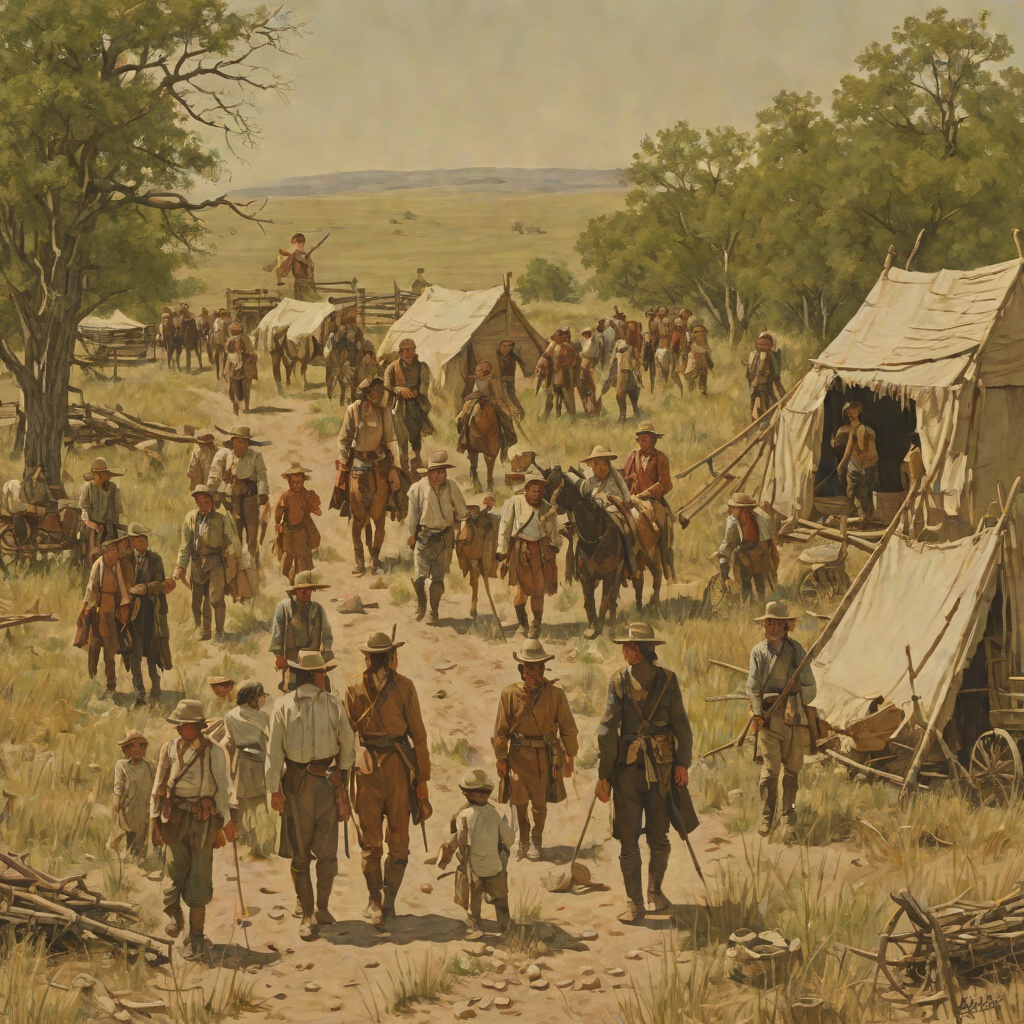
Little House on the PrairieThe Indian removal policy is the U.S. government's program of forcing Indigenous peoples to move away from lands that white settlers wished to occupy. In Little House on the Prairie, this policy is the invisible engine driving the entire plot: it is why the Ingalls family can travel to Indian Territory in the first place, why they believe they have a right to build a home there, and ultimately why they must abandon that home. The policy is never shown as a document or an official act; it exists only as a set of explanations Pa gives his daughters, a rumor from Independence, and a final, decisive order that sends soldiers to remove the settlers. Through these fragments, the novel reveals the policy's double edge: it enables the family's dream of a new life even as it guarantees that dream's destruction.
The Policy as Pa Explains It
The first clear statement of the Indian removal policy comes in a conversation between Pa and Laura after the family has encountered Indians near their new home. When Pa comes home and is told about the visit, he looks serious and says, "But all's well that ends well," adding, "And soon all the Indians here will move west." Laura asks why they go west, and Pa explains: "When white settlers arrive in a place, the Indians have to move away from there." When she presses further, asking why, Pa answers plainly: "The government makes them. Laura. That's why we're here. Lots of white people are going to come and live here. We came first to choose the best land." This is the policy reduced to its simplest form: the government compels Indigenous peoples to relocate so that white settlers can claim the land. Pa presents this not as a tragedy or an injustice but as the natural order of things, the very reason his family is entitled to be where they are. His phrasing "we came first" is telling: the Ingalls family's priority in choosing land is framed as a reward for arriving early, not as an intrusion into territory that belongs to others.
The Policy's Role in the Family's Decision to Go West
The removal policy is woven into the family's original decision to leave Wisconsin. At the very opening of the book, Pa tells Ma about the Western country: "The land is flat and the grass grows thick and high. Animals run freely and there are no settlers. Only Indians live there." The absence of settlers is precisely what attracts Pa; the presence of Indians is presented as a minor detail, not an obstacle. The family leaves their little house in Wisconsin, which they never see again, and travels across Wisconsin, Minnesota, Iowa, and Missouri before crossing Kansas. Throughout this journey, the policy is the unspoken precondition: the land is available because the government has made it available, by removing or planning to remove the Indigenous peoples who live there. Pa's enthusiasm for a country where "the animals lived without fear" extends to a country where the human inhabitants are expected to leave without resistance. The policy thus shapes not only the family's destination but their entire sense of what the West offers.
The Policy Versus Pa's Dream of a Permanent Home
Pa's belief in the removal policy is bound up with his dream of building a permanent home. When the house is finished, he tells Ma, "Before winter comes I'll make a wood floor and a solid roof. But that must wait until I finish helping Mr Edwards and building a stable. We're going to do well here, Caroline. We'll be happy here for the rest of our lives." This promise of permanence depends entirely on the assumption that the government will keep the land for the settlers and move the Indians west again. Pa repeats this confidence when he returns from Independence with a plough and seeds: "I tell you, Caroline, when these seeds grow in this rich land of ours, we'll be living like kings!" The phrase "living like kings" recurs throughout the book as Pa's vision of the reward for his labor. Yet the same trip that brings the plough and seeds also brings the first rumor that undermines the dream: "People in Independence say the government is going to move the white settlers out of Indian Territory." Ma's response, "Oh. no! Not when we have done so much," captures the family's investment in the land. Pa dismisses the rumor: "Well, I don't believe what I heard. The government has always let settlers keep the land. I think they'll make the Indians move west again." His faith in the removal policy is so complete that he cannot imagine it being applied to his own family.
The Policy Reverses: Soldiers Come for the Settlers
The reversal comes when the policy that was supposed to protect the settlers turns against them. One day Mary and Laura hear Pa's voice, loud and angry, and see him in the field with Mr Edwards and Mr Scott. Pa declares: "No, Scott! I won't stay here until the soldiers take me away like a criminal. The government in Washington told us it was all right to build our houses here. But if now they want us to go, we'll go. We won't wait for the soldiers to make us leave. We're going now!" When Ma asks where they are going, Pa answers, "I don't know, Caroline! But we're going. We're leaving here. Scott and Edwards say the government is sending soldiers to make the settlers leave Indian Territory." The policy has come full circle: the same government that encouraged white settlement by removing Indians now removes the white settlers themselves. Pa's face is very red and his eyes are like blue fire; Laura has never seen him look like that. The removal policy, which Pa had presented as a benign mechanism of progress, is revealed as a force that can be turned on anyone. The family's dream of living like kings collapses into a hasty departure.
The Policy's Aftermath and the Family's Departure
The family's departure is marked by quiet sadness and Pa's attempt at reassurance. That night, Ma says gently, "A year gone. Charles," and Pa answers with a smile, "What's a year? We have all the time in the world." The next morning they pack the wagon, leaving behind the plough because it is the only thing they cannot take. As they drive away, Pa says, "It's a great country, Caroline. But there will be wild Indians and wolves here for many years." This final remark reveals the policy's incomplete work: even after the removal of the settlers, the land is still imagined as belonging to Indians and wolves, not to white families. The novel ends with Laura feeling excited inside despite the family's loss, and with the reflection that "You never know what will happen next, nor where you will be tomorrow, when you are travelling in a covered wagon." The removal policy has uprooted the family once again, but the narrative frames this not as a tragedy but as the adventure of frontier life. The policy's victims are doubled: the Indians who are removed to make way for settlers, and the settlers who are removed when the policy changes direction. In both cases, the government's power over the land is absolute, and the individuals who live on it are merely temporary occupants.